
HS2: the cancellation figure no independent body has checked
Why the case for spending up to £62bn more on HS2 needs an independent review before the Budget.
Summary
The Department for Transport, not HS2 Ltd, added the 66% optimism bias to the HS2 cancellation estimate. Take it out and even the highest cancellation estimate is about £12bn below the lowest cost to finish Phase 1.
One-page briefing (PDF): the finding, the numbers and the ask, on a single page to share or print.
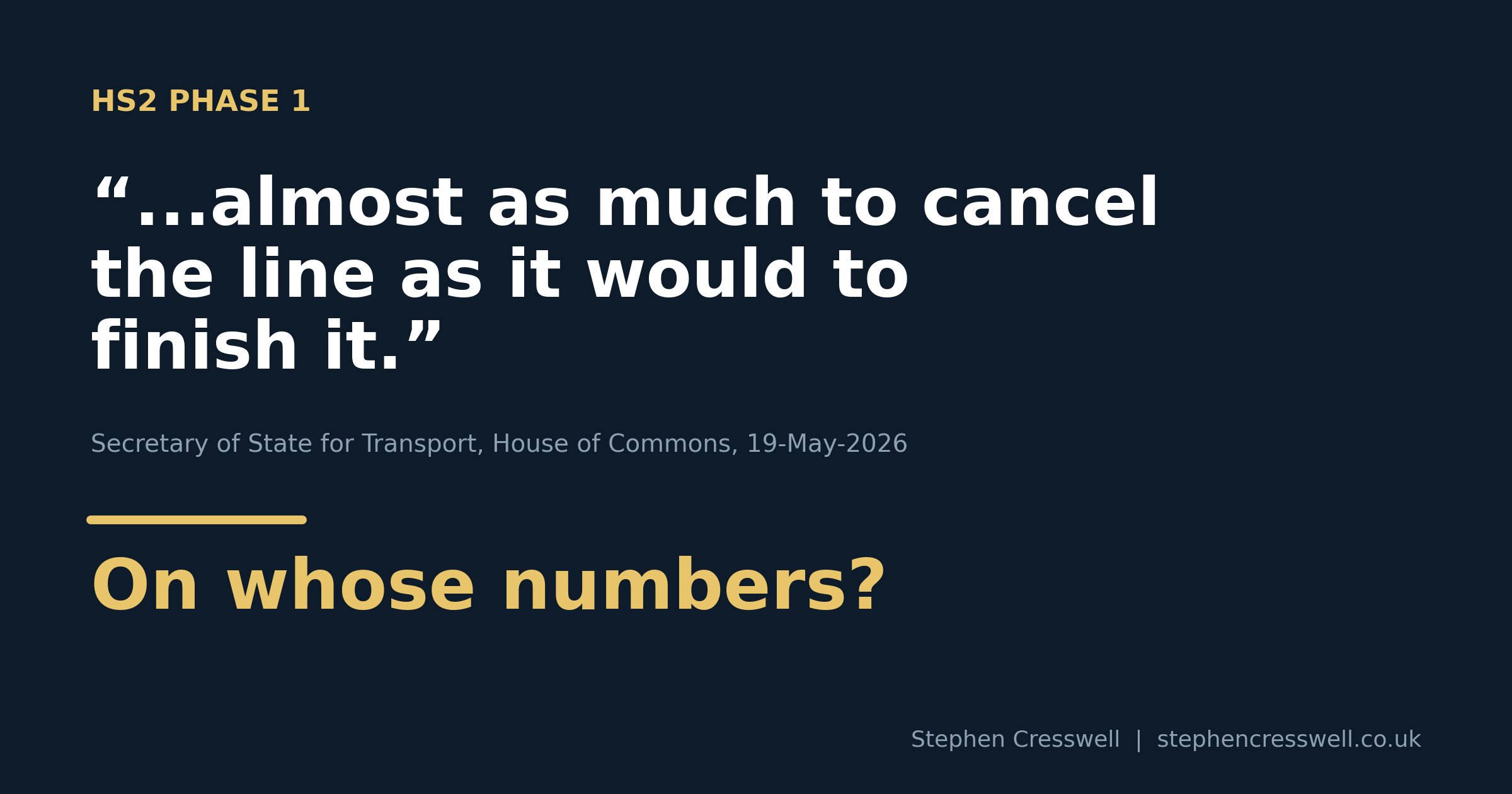
That matters because in May the DfT concluded that finishing HS2 Phase 1 is ‘likely’ to return more than £1.50 in benefits for every £1 still to be spent.1 Below £1.50, the DfT classes a project as “Low” value for money. The same day, the Secretary of State told Parliament that “it could cost almost as much to cancel the line as it would to finish it”.2 Both claims depend heavily on the cancellation figure: the higher it is, the better the case for carrying on looks.
HS2 Ltd’s chief executive sent the estimate as his advice, saying “we have also applied an optimism bias of 66%”. My Freedom of Information (FOI) request shows it was the DfT that applied it, and HS2 Ltd holds no record of how that level was chosen. In my assessment, the basis for applying the 66% is unsound, and no body without a stake in the answer has formally checked it.
With another £47bn to £62bn of public money at stake, I think the assessment behind the decision should be independently reviewed, and the Chancellor has good reason to ask for it before the Budget.
A benefit-cost calculation that looks wrong
At the Public Accounts Committee (PAC) on 14-Sep-2026, the DfT put the benefits of HS2 Phase 1 at “about £36 billion”.3 The overall cost of the scheme is now given as £87.7bn to £102.7bn, including the money already spent.4 The Accounting Officer Assessment itself says that had today’s costs been known when construction was approved in 2020, “the range would be 0.3-0.4”.5 That is 30 to 40 pence back for every taxpayer pound spent.
However, the same assessment says it is “likely” that the benefit-cost ratio (BCR) for finishing Phase 1 “exceeds 1.5”, although the actual number is not given.6 This threshold matters. Under the DfT’s own value-for-money categories, a BCR between 1 and 1.5 is “Low” value for money and between 1.5 and 2 is “Medium”.7
Most of the movement from 0.3-0.4 to above 1.5 comes from two steps: leaving out money already spent, and counting the cost of cancelling as a saving. Both are standard practice and neither is the problem on its own.
How the BCR is built
First, money already spent is ignored. Economists call it sunk cost, and leaving it out is correct. On HS2, £40.9bn had been spent by September 2025.8
Second, the cost of stopping counts as a saving from carrying on. Cancel HS2 and you still pay: contracts settled, claims met and half-built structures made safe or taken down. Finish it and that money isn’t spent. In effect, the cost used in the BCR is the difference between continuing and stopping at a point in time.
Put the two steps together and you get a simple sum.
Net cost of finishing = cost to go minus cost of cancelling
That sum has a property that is not immediately obvious on reading the published materials. The bigger the cancellation estimate, the smaller the net cost of finishing and the better the BCR for finishing looks. So the cancellation estimate deserves proper scrutiny. As far as I can tell, this has not happened.
The passage of time also helps the BCR. HS2 is spending around £7bn a year.9 Every year that passes, the cost to go falls. Meanwhile, as HS2 Ltd’s own advice acknowledges, the cost of cancelling may rise with continued construction activity.10 Both improve the business case for finishing, whatever the railway is actually worth.
A short detour into HM Treasury process and ‘optimism bias’
Government spending decisions are meant to follow HM Treasury’s Green Book, the rulebook for appraising public money. Big decisions also need an Accounting Officer Assessment, in which the department’s most senior civil servant confirms that the spending is lawful, proper, feasible and good value. For HS2 that is the DfT’s Permanent Secretary.
History shows that project costs tend to be underestimated and benefits overestimated. The Green Book deals with this through ‘optimism bias’: an uplift added to an estimate to correct for that known tendency. The technical method for setting the uplift is called reference class forecasting. Suppose you’ve built 20 hospitals and on average they overran by 20%. Reference class forecasting says that a more reliable estimate for the next hospital is the calculated figure plus an uplift for risk of 20%. The uplift draws on the track record of similar projects that came before.
Two things follow. The uplift is only as good as the reference class, so the past projects have to be like the one being estimated. And the uplift goes on a ‘bare’ estimate without risk. If the estimate already carries its own allowance for risk, adding the full uplift on top potentially counts the same risk twice. The DfT’s own 2021 evidence base confirms this: uplifts “should be applied to the base cost estimate for projects and not to any estimates that include contingency”.11
The cancellation cost advice, and how I read it
On 15-May-2026 Mark Wild, HS2 Ltd’s chief executive and accounting officer, sent his advice on the cost of cancellation to the DfT’s Permanent Secretary. It put the cost at “£33 billion to as high as £58 billion” in 2025 prices.12 When the decision to continue was assessed in October 2023, the DfT’s accounting officer put the cost of remediation if Phase 1 were cancelled at £11bn, in 2019 prices.13 In my view, there is an obvious problem when the organisation whose future depends on the answer is the one estimating the cost of cancelling it.
The letter was clear about the uniqueness of cancellation. Cancelling a programme of the scale of HS2 “is unprecedented in the western world”, it said, and “accurate estimates are impossible to benchmark”. It explained that the law as it stands would require full remediation, demolishing what has been built and returning the land to its previous condition. The estimate uses a “Realistic Remediation Scenario” instead, which in practice depends on legislation to relax the duty to demolish. The letter gives little detail about what the scenario would involve or how it was costed. Remediation was costed at 35% to 55% of the money spent so far on civils and stations.14
Then came the critical sentence: “Given the huge uncertainties of this assessment, we have also applied an optimism bias of 66%”.15 That meant applying a benchmark uplift to an estimate the same letter had just said couldn’t be benchmarked. I read “we” in that sentence as HS2 Ltd, as I believe most people would. The letter also describes itself as “my advice following my review of the estimated costs of cancellation and remediation, from my position as High Speed Two (HS2) Ltd Accounting Officer.”
Wild was candid about how much rides on the cancellation cost. The estimate “has a big impact on the overall Benefits Cost Ratio (BCR) in your Accounting Officer Assessment. It is important that we are clear about that”.16
The Accounting Officer Assessment
The assessment was published on 19-May-2026. It compares two options only: finish Phase 1, or cancel and remediate. It describes the cancellation figure as one that “DfT and HS2 Ltd have produced”, confirms that sunk costs are excluded and cancellation costs are included, and concludes that the benefit-cost ratio “exceeds 1.5”.17
In my view the Accounting Officer Assessment summary is not clear about how much the cancellation costs affect the BCR, only that they have been factored in. It says optimism bias has been applied, but not at what level. The Treasury guidance for this type of project sets a range from 6% to 66%. There is no sensitivity test showing what happens to the BCR at a lower level.
The Minister’s statement, and the Transport Committee
The same day, the Secretary of State made both a written and corresponding oral statement to Parliament. Her statement put the cost of cancelling at the centre of the decision. The written statement said that cancelling “could cost as much as completing HS2, and would result in no lasting benefit”. The statement also said the new cost estimates had been “thoroughly assessed and scrutinised, including by a panel of experts who have successfully delivered railways internationally and domestically”.18 In the Commons, that became “an independent panel of experts”.19
The next morning, Wild told the Transport Committee how the cost to complete had been checked. There were “three levels of defence”: a separate team checking every estimate, “a completely independent group of professional services people” checking the process, and “a very expert independent panel” at the top. Dean Creamer, the DfT’s senior responsible owner for HS2, said the first question now asked of any new piece of work is: “Has it been through that independent checking?”20
In my opinion, this is the standard taxpayers should expect of all critical inputs to decisions. Nobody at the session said whether the cancellation estimate had met it.
The PAC hearing, and what I wrote to the Committee
At the PAC on 14-Sep-2026, Rupert Lowe MP asked whether the cancellation figure should be independently verified. Wild’s answer: “I completely understand the concern that we had a vested interest.” He described the 35% to 55% as “a range of uncertainty” and, having referred to “the methodology that the DFT have used”, added: “They applied 66% on top of that for estimating uncertainty.”21
Set against the “we” in his letter, “they” could as easily have meant his own team. Nobody asked who “they” were, and nobody volunteered it.
When Mr Lowe pointed out that 66% was the maximum optimism bias that could be applied, the Permanent Secretary said it was “an appropriate optimism bias to apply to a programme of this scale of immaturity, given that we do not have a programme to cancel”. Asked later whether the Department would commit to an independent review, she said it had made “a proportionate assessment” and would consider a review if the Committee recommended one.22
I wrote to the Committee’s Chair on 17-Sep-2026.23 I made clear I wasn’t suggesting impropriety. My point was structural: the organisation whose continuation depends on the number had produced it, and nobody outside HS2 Ltd and the DfT had tested it. I questioned how a construction overrun figure could apply to taking a railway apart, when no reference class of cancelled projects exists. I also wanted to know why the optimism bias uplift came from 2004 guidance rather than the DfT’s own 2021 evidence, and whether any adjustment had been made to the £36bn of benefits. Finally, I asked the Committee to recommend the independent review of cancellation costs that Mr Lowe had proposed.
What the FOI response revealed
In August I had asked HS2 Ltd, under the Environmental Information Regulations, for basic facts about the cancellation estimate: dates, versions, who wrote it and how it was checked. Nothing confidential. The reply arrived on 15-Sep-2026, the day after the hearing. I hadn’t read it properly when I wrote my first letter.24 At that point I still understood that the cancellation cost advice had been produced and assured within HS2 Ltd, reviewed within the DfT and then used as an input to the Accounting Officer Assessment. Reading the FOI response, I had to update that understanding.
| Question | HS2 Ltd’s answer |
|---|---|
| Who commissioned it, and when? | The DfT, on 18-Nov-2025, as part of its Accounting Officer Assessment. The first controlled version is dated nine days later. |
| Was a quantitative risk analysis done? | No. It is a “Class 5” order-of-magnitude estimate built on “assumptions, engineering judgement, benchmarking and scenario analysis”. |
| Is there an assumptions log? | No. 41 assumptions and 12 exclusions sit inside the methodology document. |
| Did it go through HS2 Ltd’s standard estimating assurance? | No. |
| Was it reviewed by anyone else? | “Review and challenge” by Boston Consulting Group (Jan-2026) and the DfT’s project representative (Feb-2026), outside the standard process. |
| Who applied the 66%? | The DfT, “as part of its wider appraisal process”. It “did not form part of the HS2 Ltd estimate”. |
| Were any other uplifts tested? | No. |
Asked whether anyone had assessed the factors the Treasury guidance uses to bring the uplift down from 66%, HS2 Ltd said it held no information, because the uplift was applied by the DfT.
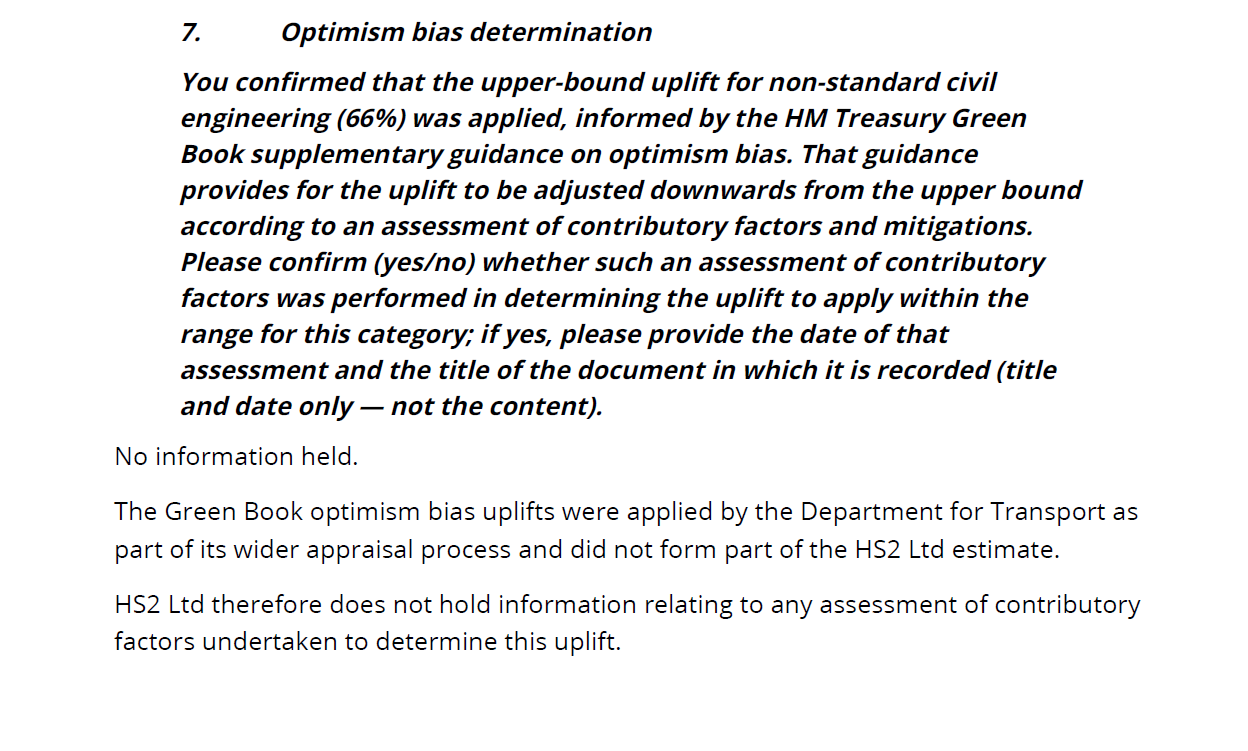
So the “we” in Wild’s letter was not HS2 Ltd. The uplift was the DfT’s. That changed my understanding of what had happened, and what I think needs reviewing.
Why I changed my advice
I wrote to the Committee again on 18-Sep-2026 with the FOI response and a modification to my advice.25 If the DfT applied the uplift, the questions reach beyond HS2 Ltd’s estimate into the DfT’s own appraisal. So I suggested the priority for any independent review should be the Accounting Officer Assessment itself. On 25-Sep-2026 I sent the Committee a supplementary memo, dated the day before, setting out why, and said I was happy for it to be published.26
Three things stand out once the letter, the hearing and the FOI response are put together.
First, there is risk on risk. HS2 Ltd’s estimate already included “scenario analysis, contingency allowances and the application of an estimating uncertainty range”.27 The DfT then added 66% on top. That is the double counting of risk the DfT’s own evidence base warns against. The Green Book guidance also expects sensitivity testing around the optimism bias figure, showing “the range of potential outcomes, not just the single optimism bias adjustment”.28 As far as we know, no other figure was tested.
Second, the two options were treated differently. The published documents don’t show an optimism bias uplift added to the £46.8bn to £61.7bn cost to complete. Its risk allowance sits inside the range, and an independent panel checked it. If a risk allowance inside the range is good enough for finishing, it’s hard to see why it isn’t good enough for cancelling.
And the proportionality defence is circular. The Department decided that working up a proper cancellation plan wasn’t a proportionate use of HS2 Ltd’s time. It then justified the maximum uplift on the grounds that “we do not have a programme to cancel”.
To be fair, 66% is not an outlandish number in itself. The DfT’s own 2021 data would allow a little more for high-speed rail at the earliest stage, around 68%.29 It is, however, much higher than the uplift in the original Phase 1 business case, which was roughly 30% on the total funding envelope.30 The 2021 data also contains benefit-shortfall figures, and we do not know whether these have been applied to the £36bn mentioned at the PAC. If they have not, applying the DfT’s UK rail class at the same confidence level as the 2020 funding envelope would reduce that figure to around £24bn.31 The bigger problem is that no reference class of cancelled high-speed railways exists for any cancellation cost uplift to come from, and whatever the figure, it was added on top of risk already counted.
What happens without the 66%
So take the 66% off and test the Secretary of State’s claim on its own terms. Dividing by 1.66 gives an underlying cancellation estimate of about £19.9bn to £34.9bn.
Without the 66% uplift, even the maximum cancellation cost, £34.9bn, is about £12bn less than the minimum remaining cost to go, £46.8bn. This is the same comparison Wild’s own letter makes, in 2025 prices on both sides.32 The claim that cancelling would cost almost as much as finishing rests on the 66%.
What this does to the BCR, I can’t say. The DfT hasn’t published the number, and the full appraisal includes operating and renewal costs that I don’t have. That is exactly why the DfT should publish its own sensitivity test.
Why it needs a full independent review
The decision to carry on was ministerial, but ministers decide on advice, and this advice came from officials. The DfT commissioned the HS2 cancellation estimate, applied the 66% uplift and then signed the assessment that relied on it. Apart from Boston Consulting Group’s review and challenge, the checking was done “within DfT”, which found the approach “reasonable in consideration of its use case”.33
I’m not suggesting anyone acted in bad faith. The problem is structural. The organisation whose future depends on the number produced it, the department that relied on it applied the uplift, and nobody without a stake in the answer has looked. A review of the cancellation estimate alone would miss half of what subsequently came to light in the FOI response. An independent review needs to cover the Accounting Officer Assessment as a whole, since that is the document on which the money is being committed.
As a minimum, the DfT should publish:
-
the actual BCR, with the underlying figures and calculations
-
how risk and optimism bias were treated in the cost to complete, set against the cancellation estimate
-
how sensitive the benefit-cost ratio is to the cancellation figure
-
what allowance, if any, has been made for benefits falling short
Why before the Budget
The Chancellor delivers the Budget on 28-Oct-2026.34 Every pound committed to HS2 has to come from somewhere: tax, borrowing or other spending.
The Treasury is not a bystander here. Wild’s letter thanks the “collaborative work on this complex issue between the department, HS2 Ltd and HM Treasury”.35 The Treasury writes the Green Book whose optimism bias guidance was applied. It also sits on the major programmes decision panel, alongside the Cabinet Office and the National Infrastructure and Service Transformation Authority.36 Wild’s letter was cleared to be shared with the members of the “Mega Projects Decision Panel”.37 So the Chancellor doesn’t need to wait for anyone: he already has the numbers he needs. The Treasury can ask for the cancellation estimate to go through the same independent checking as the cost to complete, or ask an independent party to look at the assessment as a whole.
An independent review costs little compared with the HS2 budget, and it would settle a question many taxpayers will be asking. If the case stands up, the review will show it. If it doesn’t, the money shouldn’t be committed, regardless of whether it would come from taxes, borrowing or cuts elsewhere. Before another £47bn to £62bn goes in, somebody without a stake in the answer should check the sum.
Stephen Cresswell has over 20 years’ experience in project risk and value management on major UK infrastructure, including HS2, and gave written evidence to the Public Accounts Committee on HS2 in June 2026. Read my correspondence with the Committee or download the one-page briefing (PDF).
First published 28 September 2026. Updated 1 October and 9 October 2026.
Notes
-
Department for Transport, High Speed 2 (HS2) Phase 1: decision to continue delivery following programme reset – Accounting Officer Assessment summary (May 2026), published 19-May-2026, section 5 (Value for money) and section 2 (Overview). Link. ↩︎
-
Secretary of State for Transport, oral statement to the House of Commons on the HS2 six-monthly update, 19-May-2026.↩︎
-
Public Accounts Committee, oral evidence: Delivering HS2 and Euston, HC 611, 14-Sep-2026. Benefits at Q12 (Dean Creamer, Director General Major Rail Projects, DfT). Mark Wild at Q17. Permanent Secretary Jo Shanmugalingam at Q19 and Q52. Link. ↩︎
-
HS2 six-monthly report to Parliament, 19-May-2026, financial annex: total cost range £87.7bn to £102.7bn in a mixed price base (spend to date in cash, future work in Q3 2025 prices excluding inflation); spend to September 2025 £40.9bn; HS2 programme budget for 2026-27 £7.1bn.↩︎
-
See note 1.↩︎
-
See note 1.↩︎
-
Department for Transport, Value for Money Framework: supplementary guidance on categories (November 2024). Poor: BCR between 0 and 1. Low: between 1 and 1.5. Medium: between 1.5 and 2. High: between 2 and 4. Very high: above 4. Link. ↩︎
-
See note 4.↩︎
-
See note 4.↩︎
-
Mark Wild, Chief Executive Officer, HS2 Ltd, HS2 cancellation cost advice, letter to Jo Shanmugalingam, Permanent Secretary, DfT, dated 15-May-2026, published 19-May-2026 at gov.uk/government/publications/hs2-cancellation-cost-advice. Link. ↩︎
-
Oxford Global Projects for the Department for Transport, Updating the evidence behind the optimism bias uplifts for transport appraisals (2021), section 3.1.5 (Base cost estimates). High-speed rail figure from the accompanying TAG optimism bias workbook, High Speed Rail sheet: mean uplift at Strategic Outline Business Case stage 67.5%.↩︎
-
See note 10.↩︎
-
Committee of Public Accounts, HS2 and Euston, Tenth Report of Session 2023-24 (HC 67), 7-Feb-2024, paragraph 3: “The Accounting Officer also confirmed that remediation costs … would be £11 billion (2019 prices)”. The same paragraph describes these as “the amount the Department would have to pay if Phase 1 were to be scrapped”. The October 2023 Accounting Officer Assessment summary itself gives no figure. The £11bn is in 2019 prices and the current estimate in 2025 prices, so part of the increase is inflation. Link. ↩︎
-
See note 10.↩︎
-
See note 10.↩︎
-
See note 10.↩︎
-
See note 1.↩︎
-
Secretary of State for Transport, written statement to Parliament, HS2 6-monthly report to Parliament: May 2026, 19-May-2026.↩︎
-
See note 2.↩︎
-
Transport Committee, oral evidence: HS2 Progress Update, HC 78, 20-May-2026. Mark Wild at Q8 to Q9 (three levels of defence and the major programmes decision panel with NISTA, the Cabinet Office and Treasury). Dean Creamer at Q10 (independent checking).↩︎
-
See note 3.↩︎
-
See note 3.↩︎
-
Letters from the author to Sir Geoffrey Clifton-Brown MP, Chair of the Public Accounts Committee, 17-Sep-2026 and 18-Sep-2026. Link. ↩︎
-
HS2 Ltd, response to Environmental Information Regulations request FOI-26-6339, Annex A, received 15-Sep-2026: answers 1 (document schedule), 2 (commissioning), 3 (versions), 4 (authorship and assurance), 5 (risk analysis), 6 (assumptions), 7 (optimism bias) and 8 (sensitivity). Link. ↩︎
-
See note 23.↩︎
-
Supplementary memorandum from the author to the Public Accounts Committee, The cancellation cost counterfactual in the HS2 Phase 1 Accounting Officer Assessment (May 2026), 24-Sep-2026. Link. ↩︎
-
See note 24.↩︎
-
HM Treasury, Supplementary Green Book Guidance: Optimism Bias (2004), paragraph 3.18. Link. ↩︎
-
See note 11.↩︎
-
Author’s working from the HS2 Phase 1 Full Business Case (April 2020): point estimate £34.7bn and funding envelope £45bn, set at the 75th percentile (Q3 2019 prices), an uplift of about 30%.↩︎
-
TAG optimism bias workbook, UK benefit sheet: UK rail benefit shortfall of -34% at the 75th percentile at Full Business Case stage (N=14), applied to £36bn. Author’s calculation, as set out in the letter of 17-Sep-2026.↩︎
-
Author’s calculation. Pre-uplift figures are the published range divided by 1.66. The comparison sets the highest pre-uplift cancellation figure (£34.9bn) against the lowest cost to go (£46.8bn). The cost to go is in Q3 2025 prices excluding inflation and the cancellation estimate is in 2025 prices, the same basis on which Wild’s letter compares them. This is not a benefit-cost calculation.↩︎
-
See note 10.↩︎
-
HM Treasury has confirmed the Autumn Budget for Wednesday 28-Oct-2026.↩︎
-
See note 10.↩︎
-
See note 20.↩︎
-
See note 10.↩︎
No responses yet